Updated 8 October 2026 · By Vilrita · Yarn specs are the manufacturers' label data as listed on our product pages.
A bag that holds its shape? Jump to bag yarns and the swatch test.
The best crochet yarn for each project
Twelve projects, each with the fabric to aim for, the yarn and hook, our pick plus one alternative, and a quick swatch check. Select a project to jump to it.
| Project · level* | Fabric and yarn | Hook | Our pick | Fabric check |
|---|---|---|---|---|
| First project · Beginner | Even stitches you can see, count and unpick. Smooth, light-coloured cotton or cotton-acrylic, DK to Aran (CYC 3–4) | Your pattern's hook; without one, the hook on the label (5 mm for Jeans Plus) |
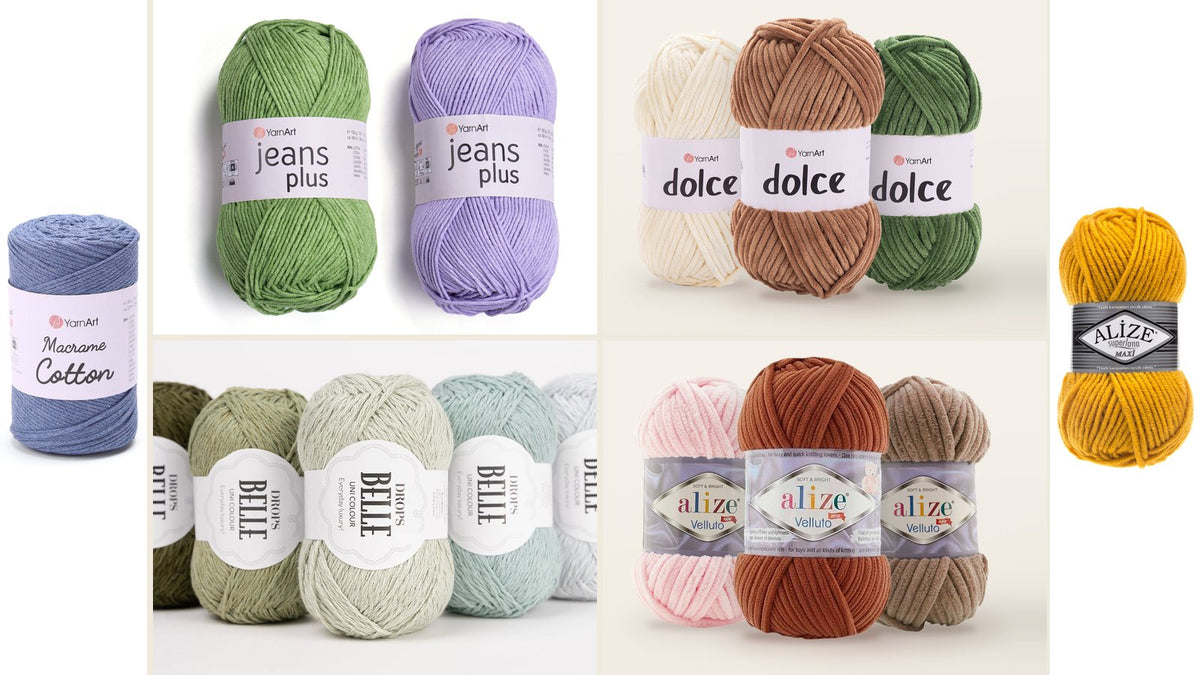
YarnArt Jeans Plus or Gazzal Baby Cotton XL |
You can count every stitch of a 10 cm practice square. If the hook drags because you crochet tightly, go up a size. |
| Plush toy · Advanced beginner | Firm and dense, so no stuffing shows. Polyester chenille, toy weight (about 120 m per 100 g) | Often 4–6 mm on the label, not the 9–15 mm the CYC chart gives for this thickness |
HiMALAYA Dolphin Baby or YarnArt Dolce |
Squeeze a stuffed test piece: no stuffing should show. If loops work loose ("worm"), crochet more tightly (Lion Brand). |
| Bag, basket · Beginner | Dense, with little stretch. Braided cotton cord, polyester cord or paper raffia | The recommended hook; try one size smaller for a denser fabric |
YarnArt Macrame Cotton or YarnArt Macrame |
A tugged swatch springs back, and the finished bag keeps its shape with your usual load inside. Straps can stretch even when the body holds its shape, so reinforce them (Mary Maxim). |
| Detailed amigurumi · Advanced beginner | Tight and crisp, with no gaps. Smooth cotton-acrylic, sport (CYC 2) | One or two sizes below the label: 2.5–3 mm for Jeans |
YarnArt Jeans Guide: best yarn for amigurumi: cotton vs chenille |
No stuffing shows through a stuffed test piece. If you can barely get the hook into the stitches, go back up a size. |
| Chunky blanket, floor cushion · Beginner; Advanced beginner for chenille | Soft, with drape. Acrylic-wool blend or polyester chenille, chunky to super chunky (CYC 5–6) | 8–10 mm, as on the label of both yarns |
Alize Superlana Maxi or Alize Velluto (chenille, after a first project) |
The fabric drapes over your hand; if it stands up stiffly, go up a hook size (Easy Crochet). A floor cushion can be firmer. |
| Granny squares · Beginner | Flat squares that all come out the same size. Acrylic or cotton-acrylic, sport (CYC 2), in 50 g balls for many colours | 3.5 mm for YarnArt Baby, as on the label |
YarnArt Baby or YarnArt Jeans |
Squares lie flat and all measure the same. Mixing two yarns? Make a square in each and compare them before joining. |
| Summer top · Advanced beginner | Light and breathable, with drape. Cotton, linen and viscose blends, sport to DK (CYC 2–3) | Whichever hook gives your pattern's gauge; start on the recommended hook, or one size larger for drape |
DROPS Belle or YarnArt Summer Dream |
A washed and dried swatch matches the pattern's stitches and rows per 10 cm. Linen softens with washing, so judge the drape after the wash (LANG Yarns). |
| Swimsuit · Intermediate | Firm, and lined. A swimwear yarn; plain cotton sags when wet | Whichever hook gives your pattern's gauge, worked firmly | We don't stock a swimwear yarn | Wet cotton stretches and gets heavy (Lion Brand), so soak a swatch: if it grows and droops, so will the swimsuit in the water. Line it even if the swatch passes. |
| Placemats, coasters, kitchen · Beginner | Dense and absorbent, with no gaps. 100% cotton; polyester cord for placemats only | 4 mm for Bouquet Unicolor, as on the label |
YarnArt Bouquet Unicolor or YarnArt Macrame (placemats only) |
Held up to the light, the swatch shows no gaps. For potholders, use a dense pattern designed for them; cotton alone isn't enough. |
| Baby clothes and blankets · Beginner | Soft, smooth and easy to wash. Smooth, non-hairy cotton, cotton-acrylic or acrylic-bamboo, DK (CYC 3) | Your pattern's gauge; 3–4 mm on the label of Organic Baby Cotton |
Gazzal Organic Baby Cotton or Alize Baby Best |
A swatch washed the way you'll wash the finished piece stays smooth and keeps its size. If it sheds or pills, choose a smoother yarn. |
| Warm hat, jumper · Beginner (chunky hat), Advanced beginner (jumper) | Warm and springy. Wool or wool-acrylic, DK to chunky (CYC 3–5) | Your pattern's gauge; 3–4.5 mm for Lanagold, 8–10 mm for Superlana Maxi |
Alize Lanagold Classic or Alize Superlana Maxi (chunky hat) |
A washed swatch matches the pattern's stitches and rows. Wool that isn't superwash felts in a hot wash, so wash the swatch as the label says. |
| Shawl · Advanced beginner; Intermediate for mohair | Light and open, with drape. Gradient cotton-acrylic or kid mohair, lace to fingering (CYC 0–1) | The hook on the label (3 mm for Flowers); for mohair, the top of its label range or one size larger (Quince & Co, Mary Maxim) |
YarnArt Flowers or Alize Kid Royal 50 |
The swatch looks open and hangs softly. Mohair is hard to unpick, so check each row as you go (Quince & Co). |
First projectBeginner
- Fabric
- Even stitches you can see, count and unpick
- Yarn
- Smooth, light-coloured cotton or cotton-acrylic, DK to Aran (CYC 3–4)
- Hook
- Your pattern's hook; without one, the hook on the label (5 mm for Jeans Plus)
- Our pick
-
YarnArt Jeans Plus
or Gazzal Baby Cotton XL - Fabric check
- You can count every stitch of a 10 cm practice square. If the hook drags because you crochet tightly, go up a size.
Plush toyAdvanced beginner
- Fabric
- Firm and dense, so no stuffing shows
- Yarn
- Polyester chenille, toy weight (about 120 m per 100 g)
- Hook
- Often 4–6 mm on the label, not the 9–15 mm the CYC chart gives for this thickness
- Our pick
-
HiMALAYA Dolphin Baby
or YarnArt Dolce - Fabric check
- Squeeze a stuffed test piece: no stuffing should show. If loops work loose ("worm"), crochet more tightly (Lion Brand).
Bag, basketBeginner
- Fabric
- Dense, with little stretch
- Yarn
- Braided cotton cord, polyester cord or paper raffia
- Hook
- The recommended hook; try one size smaller for a denser fabric
- Our pick
-
YarnArt Macrame Cotton
or YarnArt Macrame - Fabric check
- A tugged swatch springs back, and the finished bag keeps its shape with your usual load inside. Straps can stretch even when the body holds its shape, so reinforce them (Mary Maxim).
Detailed amigurumiAdvanced beginner
- Fabric
- Tight and crisp, with no gaps
- Yarn
- Smooth cotton-acrylic, sport (CYC 2)
- Hook
- One or two sizes below the label: 2.5–3 mm for Jeans
- Our pick
-
YarnArt Jeans
Guide: best yarn for amigurumi: cotton vs chenille - Fabric check
- No stuffing shows through a stuffed test piece. If you can barely get the hook into the stitches, go back up a size.
Chunky blanket, floor cushionBeginner; Advanced beginner for chenille
- Fabric
- Soft, with drape
- Yarn
- Acrylic-wool blend or polyester chenille, chunky to super chunky (CYC 5–6)
- Hook
- 8–10 mm, as on the label of both yarns
- Our pick
-
Alize Superlana Maxi
or Alize Velluto (chenille, after a first project) - Fabric check
- The fabric drapes over your hand; if it stands up stiffly, go up a hook size (Easy Crochet). A floor cushion can be firmer.
Granny squaresBeginner
- Fabric
- Flat squares that all come out the same size
- Yarn
- Acrylic or cotton-acrylic, sport (CYC 2), in 50 g balls for many colours
- Hook
- 3.5 mm for YarnArt Baby, as on the label
- Our pick
-
YarnArt Baby
or YarnArt Jeans - Fabric check
- Squares lie flat and all measure the same. Mixing two yarns? Make a square in each and compare them before joining.
Summer topAdvanced beginner
- Fabric
- Light and breathable, with drape
- Yarn
- Cotton, linen and viscose blends, sport to DK (CYC 2–3)
- Hook
- Whichever hook gives your pattern's gauge; start on the recommended hook, or one size larger for drape
- Our pick
-
DROPS Belle
or YarnArt Summer Dream - Fabric check
- A washed and dried swatch matches the pattern's stitches and rows per 10 cm. Linen softens with washing, so judge the drape after the wash (LANG Yarns).
SwimsuitIntermediate
- Fabric
- Firm, and lined
- Yarn
- A swimwear yarn; plain cotton sags when wet
- Hook
- Whichever hook gives your pattern's gauge, worked firmly
- Our pick
- We don't stock a swimwear yarn
- Fabric check
- Wet cotton stretches and gets heavy (Lion Brand), so soak a swatch: if it grows and droops, so will the swimsuit in the water. Line it even if the swatch passes.
Placemats, coasters, kitchenBeginner
- Fabric
- Dense and absorbent, with no gaps
- Yarn
- 100% cotton; polyester cord for placemats only
- Hook
- 4 mm for Bouquet Unicolor, as on the label
- Our pick
-
YarnArt Bouquet Unicolor
or YarnArt Macrame (placemats only) - Fabric check
- Held up to the light, the swatch shows no gaps. For potholders, use a dense pattern designed for them; cotton alone isn't enough.
Baby clothes and blanketsBeginner
- Fabric
- Soft, smooth and easy to wash
- Yarn
- Smooth, non-hairy cotton, cotton-acrylic or acrylic-bamboo, DK (CYC 3)
- Hook
- Your pattern's gauge; 3–4 mm on the label of Organic Baby Cotton
- Our pick
-
Gazzal Organic Baby Cotton
or Alize Baby Best - Fabric check
- A swatch washed the way you'll wash the finished piece stays smooth and keeps its size. If it sheds or pills, choose a smoother yarn.
Warm hat, jumperBeginner (chunky hat), Advanced beginner (jumper)
- Fabric
- Warm and springy
- Yarn
- Wool or wool-acrylic, DK to chunky (CYC 3–5)
- Hook
- Your pattern's gauge; 3–4.5 mm for Lanagold, 8–10 mm for Superlana Maxi
- Our pick
-
Alize Lanagold Classic
or Alize Superlana Maxi (chunky hat) - Fabric check
- A washed swatch matches the pattern's stitches and rows. Wool that isn't superwash felts in a hot wash, so wash the swatch as the label says.
ShawlAdvanced beginner; Intermediate for mohair
- Fabric
- Light and open, with drape
- Yarn
- Gradient cotton-acrylic or kid mohair, lace to fingering (CYC 0–1)
- Hook
- The hook on the label (3 mm for Flowers); for mohair, the top of its label range or one size larger (Quince & Co, Mary Maxim)
- Our pick
-
YarnArt Flowers
or Alize Kid Royal 50 - Fabric check
- The swatch looks open and hangs softly. Mohair is hard to unpick, so check each row as you go (Quince & Co).
*Levels are our own guide (Beginner, Advanced beginner, Intermediate), based on how easy the stitches are to see and unpick, following TL Yarn Crafts and Phildar. CYC = Craft Yarn Council weight category. Stitch names are US terms: US single crochet (sc) is UK double crochet, and US double crochet (dc) is UK treble.
What is the best yarn for crochet beginners?
Start here: one yarn, one hook, one small square
One ball of YarnArt Jeans Plus in a light shade and the 5 mm hook on its label. Crochet a 10 × 10 cm square in US single crochet (UK double crochet) until you can count every stitch.
YarnArt Jeans Plus
See colours and price →100 g balls of 160 m
Light shades to practise on
 White
White Pistachio
 Lavender
 Sand
SandA little finer: Gazzal Baby Cotton XL, 50/50 cotton-acrylic at 210 m per 100 g, with a 3–4 mm hook on the label (try a 4 mm KnitPro Zing).
| Choose | Skip for now, and why |
|---|---|
| ✓ A light or medium solid colour | ✕ Black, navy, charcoal: the loops blend together (TL Yarn Crafts) |
| ✓ A smooth yarn | ✕ Mohair, eyelash, bouclé, fluffy yarns: the fibres hide the stitches and catch when you unpick (TL Yarn Crafts, Mary Maxim) |
| ✓ Firmly twisted, two or more plies | ✕ A loosely twisted single strand: the hook goes through the fibres and splits it (TL Yarn Crafts) |
| ✓ CYC 3–4, DK to Aran | ✕ Thread or super chunky: tiny stitches are hard to see; very thick yarn is awkward to hold (TL Yarn Crafts) |
| ✓ Cotton or cotton-acrylic | ✕ Chenille: the pile hides the stitches and gets damaged when you undo work (L'Univers de Lalu) |
| ✓ One plain colour | ✕ Multicolour or fancy yarn: it is harder to keep track of your stitches and rows (Phildar) |
| ✓ Enough metres, all from one dye lot | ✕ Buying by the number of balls: lengths per ball vary, and colours differ between dye lots (L'Univers de Lalu; see how much to buy) |
Good first projects
| Project | What it teaches, yarn and hook |
|---|---|
| Dishcloth or coaster | Rows and counting YarnArt Bouquet Unicolor (100% cotton), 4 mm hook |
| Chunky hat | Working in rounds with big, easy-to-see stitches Alize Superlana Maxi, 8–10 mm hook |
| Granny square | Rounds, corners and colour changes YarnArt Baby, 3.5 mm hook |
| First toy | Magic ring, spiral rounds, increases See your first toy: the five core moves |
Want a pattern to go with it? Our 13 free autumn crochet patterns include one the designer rates "very easy".
Example shopping list for a first scarf: 4 balls of Jeans Plus from one dye lot (3 for Lion Brand's general worsted scarf estimate of 343–457 m, plus 1 spare) and a 5 mm hook. Your pattern changes the total.
Crochet hook size chart: which hook for which yarn?
| Yarn thickness | Hook (mm) | Example label |
|---|---|---|
| Fingering, sock (CYC 1) | 2.25–3.5 | YarnArt Flowers: 3 mm |
| Sport (CYC 2) | 3.5–4.5 | YarnArt Jeans: 3.5 mm |
| DK (CYC 3) | 4.5–5.5 | Gazzal Baby Cotton XL: 3–4 mm |
| Worsted, Aran (CYC 4) | 5.5–6.5 | YarnArt Jeans Plus: 5 mm |
| Chunky (CYC 5; US bulky) | 6.5–9 | Alize Superlana Maxi: 8–10 mm |
| Super chunky (CYC 6; US super bulky) | 9–15 | Alize Velluto: 8–10 mm |
| Toy-weight chenille | label, often 4–6 | HiMALAYA Dolphin Baby: 4.5 mm |
Trust millimetres: the Craft Yarn Council notes that US letter sizes vary between makers. To match a pattern's gauge, go down a hook size if you have fewer stitches per 10 cm than the pattern, and up a size if you have more. Fuzzy yarns usually like a hook about one size larger, which opens the stitches (Mary Maxim, Quince & Co).

Full chart: all eight weights, crochet gauge and US hook sizes
| CYC weight | Names, gauge and hook |
|---|---|
| 0 · Lace | US: lace, fingering, crochet thread · UK: 1–2 ply 32–42 US dc (UK treble) · steel 1.4–1.6 mm, regular 2.25 mm (B-1) |
| 1 · Super fine | US: sock, fingering, baby · UK: 3–4 ply 21–32 sc · 2.25–3.5 mm (B-1 to E-4) |
| 2 · Fine | US: sport, baby 16–20 sc · 3.5–4.5 mm (E-4 to US 7) |
| 3 · Light | US: DK, light worsted · UK: DK 12–17 sc · 4.5–5.5 mm (US 7 to I-9) |
| 4 · Medium | US: worsted, afghan, Aran · UK: worsted, Aran 11–14 sc · 5.5–6.5 mm (I-9 to K-10½) |
| 5 · Bulky | US: chunky, craft, rug · UK: chunky 8–11 sc · 6.5–9 mm (K-10½ to M-13) |
| 6 · Super bulky | US: super bulky, roving · UK: super chunky 7–9 sc · 9–15 mm (M-13 to Q) |
| 7 · Jumbo | US: jumbo, roving 6 sc or fewer · 15 mm and up (Q and up) |
Millimetres to US hook sizes: 2.25 mm = B-1 · 2.75 mm = C-2 · 3.25 mm = D-3 · 3.5 mm = E-4 · 3.75 mm = F-5 · 4 mm = G-6 · 4.5 mm = US 7 · 5 mm = H-8 · 5.5 mm = I-9 · 6 mm = J-10 · 6.5 mm = K-10½ · 8 mm = L-11 · 9 mm = M/N-13 · 10 mm = N/P-15 · 15 mm = P/Q. Sizes 2.5, 7 and 12 mm have no US equivalent.
Sources: Craft Yarn Council weight system and hook chart (ranges are guidelines; your pattern's gauge wins); Wikipedia "Yarn weight" for UK names.
What our catalogue lists as the crochet hook: 161 entries
In the 161 Vilrita catalogue entries that list a crochet hook, length and ball weight (8 October 2026), toy-weight chenille at 100–149 m per 100 g has a median listed hook of about 4.75 mm (the midpoint of the listed ranges): the same as non-chenille yarns at 150–199 m, and far below the chart's 9–15 mm.
| Metres per 100 g | Median listed hook · entries |
|---|---|
| 150–199 m, not chenille | 4.75 mm · 10 entries |
| 100–149 m, not chenille | 6.5 mm · 7 entries† |
| 100–149 m, chenille | 4.75 mm · 10 entries |
All nine bands and how we counted
| Metres per 100 g | Median listed hook · entries |
|---|---|
| 450 m and more | 3 mm · 19 |
| 300–449 m | 3 mm · 59 |
| 200–299 m | about 3.9 mm · 42 |
| 150–199 m, not chenille | 4.75 mm · 10 |
| 150–199 m, chenille | 4.75 mm · 2† |
| 100–149 m, not chenille | 6.5 mm · 7† |
| 100–149 m, chenille | 4.75 mm · 10 |
| under 100 m, not chenille | 7.25 mm · 6† |
| under 100 m, chenille | 8.5 mm · 6† |
Method: one entry per product page, so related lines (a yarn and its "Color" or "Mini" version) count separately. For each entry we took the midpoint of its listed hook range, then the median per band. "Chenille" means chenille or velvet construction, from the product page. Of 217 entries checked, 56 were left out: 11 DROPS yarns (needle sizes only), 6 hand-worked loop yarns and 39 with no crochet hook listed. Download the 161 entries (CSV).
†Fewer than 10 entries, a hint only. Manufacturers' specs as listed on vilrita.com, not ball bands we inspected one by one; one shop's range is not a sample of all yarns.
Not every chenille ball band asks for a small hook (HiMALAYA Velvet's says 8 mm), and the thickest, such as Alize Velluto at 68 m per 100 g, use big hooks like any chunky yarn.
KnitPro Waves 2.0 crochet hook
See colours and price →Sold singly, 2–10 mm
Also: KnitPro Zing (2–6 mm) and our basic crochet hooks (2–3.5 mm and 5–10 mm). See all crochet hooks.
Best yarn for a crochet plush toy or comfort toy
Chenille is a pile yarn (see the glossary). At toy weight the pile hides the stitches, so count by feel and mark often (Mary Maxim); unpicking can damage it (L'Univers de Lalu), so save it for your second project. Keep the fabric firm to hide the stuffing; if loops "worm" out of the stitches, Lion Brand suggests a very tight gauge.
What goes wrong with cheap chenille. A French crochet guide (in Sources) lists its weak points: a fragile core, and loosely fixed pile that snaps when pulled tight and sheds when undone.
For a toy meant for a child under 3, crochet or embroider the eyes. EU toy-safety law requires toys sold for children under 36 months, and their detachable parts, to be too large to swallow or inhale (Directive 2009/48/EC, Annex II; Regulation (EU) 2025/2509 replaces it from August 2030). OEKO-TEX tests for harmful substances, not for choking hazards.
HiMALAYA Dolphin Baby
See colours and price →100 g balls of 120 m
 White
White Baby Pink
 Light Blue
 Grey
Grey Caramel
 Sand
SandAlternative: YarnArt Dolce, also 120 m per 100 g, with a 4–6 mm hook on the label; YarnArt suggests it for dense toys that hold their shape. For both, start on a 4.5 mm KnitPro Zing. Browse more chenille in our plush yarn collection.
Small, detailed toys (amigurumi)
For small toys with faces and limbs, a smooth cotton-acrylic keeps details crisp. YarnArt Jeans (320 m per 100 g, 3.5 mm hook on the label) is, YarnArt says, twisted tightly enough not to split; work it one or two hook sizes below the label, 2.5–3 mm, so the stuffing stays hidden.
 Off White
 Camel
Camel Powder Pink
 Yellow
Cotton or chenille, holes, safety eyes and stuffing: our full amigurumi yarn guide →
Best yarn for a crochet bag that holds its shape
Mary Maxim's fixes for sagging bags: single crochet (UK double crochet) rather than double crochet (UK treble), firm tension, a lining of canvas, denim or twill, and straps reinforced with slip stitches or metal D-rings. YarnArt says the braid of Macrame Cotton helps the cord resist stretching.
Swatch first. A smaller hook makes tighter stitches (The Nicole Chase): if a swatch on the recommended hook pulls out of shape when tugged, try one size smaller. A firm swatch is a good sign, not a promise, so load the finished bag with what you'll really carry before you rely on it.
Care: press water out of a cord bag, never wring it, and dry it flat (Macrebag).
YarnArt Macrame Cotton
See colours and price →250 g balls of about 225 m
 White
White Silver
 Denim
Denim Teal
Teal Brick
BrickAlternative: YarnArt Macrame, 100% polyester cord at 144 m per 100 g with a 4 mm hook on the label; YarnArt suggests it for bags, and it's machine washable and quick-drying. Hooks: 5 mm for Macrame Cotton, a 4 mm KnitPro Zing for Macrame. Bases: a ready-made 30 cm or 35 cm round bag base keeps the bottom flat. Paper raffia and every other bag cord are in our macramé and bag yarn collection.
We don't stock T-shirt yarn, jute or polypropylene cord.
Which yarn for a crochet blanket or granny squares?
A blanket should drape, not stand up: if your fabric comes out stiff, go up a hook size (Easy Crochet). A big piece tires the hands, so take breaks (Easy Crochet). Chunky chenille, unlike toy-weight chenille, makes stitches big enough to see, but unpicking still damages its pile.
Alize Superlana Maxi
See colours and price →100 g balls of 100 m
 White
White Teal
Teal Ochre
OchreAlternative, once you can read your stitches: Alize Velluto, 100% polyester chenille at 68 m per 100 g, also on an 8–10 mm hook; it's sold for chunky blankets. Hooks: 8 mm, 9 mm or 10 mm.
Granny squares
Granny squares use a little of many colours, so 50 g balls make sense. YarnArt recommends YarnArt Baby for granny-square blankets: 100% acrylic, 300 m per 100 g, on a 3.5 mm hook.
 White
White Marigold
 Seafoam
 Brick
BrickAlternative: YarnArt Jeans, also in 50 g balls, for cotton-blend squares. Hook: 3.5 mm.
Two free blanket patterns, each with a matching yarn, are in our autumn crochet patterns guide. Browse thick yarns: chunky and super chunky.
What yarn for a crochet summer top or swimsuit?
Cotton feels cool against the skin, but can shrink and tighten as it dries after washing (Purl Soho). Linen starts out a little stiff and softens with every wash, and viscose adds sheen and drape but has very little stretch (LANG Yarns); viscose can also be slippery to work (TL Yarn Crafts).
Swimwear: wet cotton stretches and gets heavy (Lion Brand). We don't stock a swimwear yarn with elastane. If you crochet a bikini top, work it firmly and line it.
DROPS Belle
See colours and price →50 g balls of 120 m
 Off White
 Old Pink
 Jeans Blue
 Goldenrod
DROPS gives needle sizes only, so for Belle start on a 4.5 mm KnitPro Zing, the bottom of the DK range, and let your pattern's gauge decide. Alternative: YarnArt Summer Dream, 70% cotton and 30% viscose at 350 m per 100 g, with a 3 mm hook on the label (3 mm).
Cotton yarn for placemats, coasters and the kitchen
Cotton is "extremely durable" (Lion Brand) and absorbent (TL Yarn Crafts). Acrylic can melt near high heat, so leave it out of potholders and trivets (TL Yarn Crafts). YarnArt also suggests Macrame for placemats that resist moisture.
What can you crochet with cotton yarn?
- Dishcloths and washcloths
- Potholders (in a dense pattern made for heat) and coasters
- Placemats
- Market bags and baskets
- Cushions
Uses as listed on the YarnArt Creative and DROPS Paris product pages; coasters are our addition.
YarnArt Bouquet Unicolor
See colours and price →100% cotton, 4 mm hook on the label
 Latte
Latte Blush
Blush Butter
 Sapphire
Alternative for placemats only: YarnArt Macrame. Hook: 4 mm KnitPro Zing. More in our cotton yarn collection.
Best yarn for crochet baby clothes and blankets
Leave hairy fibres for grown-ups (L'Univers de Lalu). Our pick, Gazzal Organic Baby Cotton, is 100% organic cotton at 230 m per 100 g, with a 3–4 mm hook on the label; its page says Gazzal yarns are certified to OEKO-TEX Standard 100, without naming a class. Wash a swatch the way you will wash the finished piece before you start.
Gazzal Organic Baby Cotton
See colours and price →50 g balls of 115 m
 White
White Ice Blue
 Dusty Rose
 Cream
CreamAlternative: Alize Baby Best, 90% acrylic and 10% bamboo at 240 m per 100 g, with a 2–4 mm hook on the label. Hooks: 3 mm or a 4 mm KnitPro Zing. More DK yarns: light and DK collection.
Which yarn for a warm crochet hat or jumper?
Wool is "warm, springy and forgiving" (TL Yarn Crafts). Unless it is superwash, it felts when heat, moisture and friction meet, so a hot wash can shrink a jumper (Lion Brand). Phildar's beginners' guide doesn't recommend 100% wool for crochet, because it can split easily. Splitting depends more on how a yarn is made than on the fibre: a loosely twisted or single-ply yarn splits more readily than a firmly plied one. Both yarns here are wool-acrylic blends.
Alize Lanagold Classic
See colours and price →100 g balls of 240 m
 Cream
Cream Grey Melange
 Burgundy
 Bottle Green
Alternative for a hat with big, quick stitches: Alize Superlana Maxi, 75% acrylic and 25% wool at 100 m per 100 g, on an 8–10 mm hook. Hooks: a 4 mm KnitPro Zing for Lanagold, an 8 mm or 9 mm for Superlana Maxi. Pattern idea: the mushroom hat in our free autumn collection, a DK hat for advanced beginners. Browse worsted and Aran or chunky yarns.
What yarn for a crochet shawl?
A slightly larger hook keeps mohair airy (Quince & Co) and its stitches visible (Mary Maxim).
Want to crochet with mohair? See Mohair Yarn: A Knitter's Guide to the Fluffiest Yarn.
 Ice Blue & Denim
 Lavender & Honey
 Dusty Rose & Ruby
Alternative with a halo: Alize Kid Royal 50, 62% kid mohair at 1,000 m per 100 g. Browse cake yarns and mohair.
Example shopping list for a shawl: 1 cake of YarnArt Flowers (1,000 m) and a 3 mm hook. Check the metres your pattern asks for first.
Cotton, acrylic, wool or chenille: which fibre does what?
| Fibre | Behaviour, care and best uses |
|---|---|
| Cotton | Very little stretch, crisp stitches; can shrink and tighten as it dries · kitchen, bags, summer tops |
| Cotton-acrylic | More spring-back than pure cotton · first projects, amigurumi, blankets |
| Acrylic | Forgiving, easy-care, less breathable; can pill and melt with high heat · blankets, not potholders |
| Wool | Warm, springy; felts with heat, moisture and friction unless superwash · hats, jumpers |
| Linen, viscose | Very little stretch; linen softens with washing, viscose drapes and can be slippery · summer tops |
| Polyester chenille | Soft pile hides stitches; loops can "worm" out · plush toys, blankets, not a first project |
Which cotton yarn is best for crochet?
Choose 100% cotton for kitchen items and bags, such as YarnArt Bouquet Unicolor; a cotton-acrylic blend such as YarnArt Jeans for toys and first projects, because it springs back more; and a cotton blend with viscose and linen such as DROPS Belle for tops that drape. Mercerised cotton adds shine and crisp stitches, but no project here needs it. See all cotton yarns.
What do DK, Aran and 8/4 mean on a yarn label?
To compare yarns, work out metres per 100 g: length ÷ ball weight × 100. YarnArt Jeans (160 m in 50 g) is 320 m per 100 g; Jeans Plus (160 m in 100 g) is 160 m. Fewer metres means thicker yarn, but only between similar fibres and constructions. Swapping yarns? See the substitution card.

- Worsted, Aran
- Both CYC 4; Ravelry lists Aran as slightly thicker.
- Ply
- One strand of spun yarn, a "single". Plying twists two or more singles together, so a 2-ply yarn is two singles (Wikipedia, Spin Off). In UK and Australian weight names, "8 ply" is a thickness label meaning DK (Wikipedia, Ravelry).
- 8/4, 8/6, 8/8
- Cotton numbering: the yarn count of each single, then the number of singles plied together. A higher count means a finer single; more plies make a thicker yarn (Spin Off).
- Mercerised cotton
- Cotton treated under tension for sheen and crisp stitches; it has little give and garments can sag after washing (Lion Brand).
- Chenille
- A pile yarn: short tufts held between two twisted core threads (Simply Yarn).
- Gauge (tension), swatch
- Stitches and rows in 10 cm (4 in), checked on a test square washed like the finished piece.
How many balls of yarn do I need?
Beiges, light greys and navy show dye-lot differences most (L'Univers de Lalu). Crochet uses a little more yarn than knitting (FaveCrafts), so plan for the upper end of any estimate.
| Project | Metres and balls |
|---|---|
| Hat | 183–206 m · 2 balls |
| Scarf | 343–457 m · 3 balls |
| Baby blanket | 914–1,029 m · 6–7 balls |
| Adult jumper | 1,029–1,486 m · 7–10 balls |
| Throw | 2,057–2,858 m · 13–18 balls |
| Baby blanket in super chunky (CYC 6) | 686–800 m · 6–7 balls of Dolphin Baby (120 m) |
Lion Brand's general chart for worsted (CYC 4) unless marked, converted at 1 yd = 0.9144 m. It doesn't split knitting and crochet, and can't know your size or stitch. Size matters: the Dolphin Baby product page estimates 5–6 balls for a 76 × 76 cm (30 × 30 in) blanket.
Swapping yarns: the substitution card
- Equal metres, not balls or grams. Pattern balls × their metres per ball, divided by your metres per ball.
- Washed stitch and row gauge. Swatch at least 10 cm, wash and dry it like the finished piece, then count stitches and rows. If rows differ, the length will too.
- The same fabric. A thinner yarn on a bigger hook can hit the stitch count but gives a looser fabric (The Nicole Chase, Easy Crochet). Fibre and construction change drape and stretch: cotton is not wool, and chenille is not smooth yarn.
Example: a pattern asks for 6 balls of 150 m, so 900 m. Jeans Plus has 160 m per ball: 900 ÷ 160 = 5.6, so 6 balls plus 1 spare, but only if your washed swatch matches the pattern's stitches, rows and drape.

Browse by brand: YarnArt, Alize, HiMALAYA, Gazzal and DROPS.
Frequently asked questions
Can you crochet with knitting yarn?
Usually, yes: yarn is sold by thickness, not by craft, and a yarn sold for knitting can be crocheted if it gives the fabric your pattern needs. DROPS, for example, lists only needle sizes, so take the hook from your pattern's gauge. The clear exception is loop yarn such as Alize Puffy, which you work with your fingers, not a hook (product page). See the hook chart.
What size crochet hook is best for a beginner?
The one that gives your pattern's gauge, starting from the size it names. Without a pattern, start with the hook on the label of a DK to Aran yarn, often 3–5 mm (YarnArt Jeans Plus says 5 mm). Advice varies from 4.5 mm (the Craft Yarn Council's DK range) to at least 7 mm (Phildar), because a hook size only makes sense with its yarn. More in yarn for beginners.
What hook size do I need for chenille or plush yarn?
Start with the label, often 4–6 mm for toy-weight chenille, not the 9–15 mm the Craft Yarn Council chart gives for super chunky yarn, and work firmly. Gaps in a stuffed toy usually mean the hook is too big for the yarn (The Nicole Chase); our amigurumi yarn guide shows how to fix them.
Which yarn stretches least for a crochet bag?
No yarn guarantees a bag won't stretch, but some are less prone to it: braided cotton cord, polyester macramé cord and paper raffia. Work them in dense US single crochet (UK double crochet), test a swatch, add a firm base, and line the bag or reinforce the straps. Compare them in yarn for bags.
Is cotton or acrylic better for crochet?
Neither is better overall: cotton suits anything that meets water or must keep its shape, such as dishcloths, bags and summer tops, while acrylic suits soft, washable blankets but not potholders. Cotton-acrylic blends sit in between; see the fibre cheat sheet.
Does cotton yarn shrink?
Yes, it can shrink and tighten as it dries after washing (Purl Soho), especially when washed hot (Mary Maxim). Check the care symbols and wash your swatch before measuring. More on reading a yarn label.
Can I use DK instead of worsted in a pattern?
Sometimes. DK is thinner, so a bigger hook may give the pattern's stitch count but a looser, more open fabric. Swatch, wash and dry it, and match the stitches, rows and drape the pattern needs; then recalculate metres from the pattern, not from a general table. See the substitution card.
What is a dye lot and why does it matter?
The batch a ball was dyed in, printed on the label. Colours can differ slightly between lots (L'Univers de Lalu), so buy every ball at once, from one lot, plus a spare. See how much yarn.
Is thick or thin yarn easier to crochet?
Medium yarn, DK to Aran (CYC 3–4), which TL Yarn Crafts calls "a comfortable middle ground". Thread makes tiny stitches that are hard to see, and super chunky yarn is awkward to hold. More in what the label numbers mean.
Sources
- Craft Yarn Council: Standard Yarn Weight System and Hooks and needles
- Lion Brand: working with cotton, mercerised cotton, superwash wool, how much yarn do I need, chenille loose loops
- TL Yarn Crafts: best yarns for beginners and guide to yarn fibres
- Mary Maxim: crocheting with fluffy yarn, stopping bag straps stretching and acrylic vs cotton
- The Nicole Chase: amigurumi hook size
- Quince & Co: working with mohair
- LANG Yarns: linen and bamboo viscose
- Purl Soho: knitting with cotton yarn
- Easy Crochet: plush blanket yarn
- Spin Off: what yarn numbers mean
- Wikipedia: Yarn weight and Plying; Ravelry: yarn weights
- Phildar: quel fil et quel crochet choisir quand on débute
- L'Univers de Lalu: choisir son fil pour débuter au crochet
- Croch'ta Maille: se réconcilier avec le fil chenille
- FaveCrafts: does crochet use more yarn than knitting?
- Macrebag: how to wash a crochet bag
- Simply Yarn (Gathered): chenille yarns
- EUR-Lex: Toy Safety Directive 2009/48/EC and Regulation (EU) 2025/2509 on the safety of toys
- OEKO-TEX Standard 100
1 comment
Sarah
Bonjour, quel type de laine choisir pour faire un taie d’oreiller en crochet ?
Bonne journée !